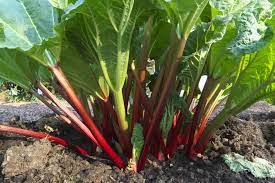
Rhubarb, Rheum rhabarbarum, originated in southern Siberia, on the border with Mongolia. Some say the name is of latin origin — yet the Greeks were using it for medicine before Roman times, and they called it rheon, which is related to a Persian word for the plant. The ‘barberum’ part of the name means ‘foreign.’

The Genus name ‘Rheum,’ comes from central Asia’s Rha River, named by the Scythians, now called the Volga River. The region has been inhabited for 9000 years, but at what point the inhabitants began to use Rhubarb or even how it arrived there from Siberia, we can only speculate. They must have grown a lot of rhubarb in the Volga floodplain, facilitated by the well-drained fluvial sediments with a high organic content. Thus, Rhubarb means ‘foreigner’s plant from the Rha River Valley.’
As long ago as 5000 years ago, the Chinese used the woody roots of Rheum palmatum for medicine: to relieve diarrhea, fevers, and constipation. [Constipation was a frequent problem in days past, due to the unavailability of fresh fruits and vegetables for months at a time.] Medicines that promoted bowel function were called ‘cathartic’ or ‘purgative.’

Along the Silk Road, formalized in 130 BCE, rhubarb roots were traded widely. Their laxative properties were in high demand and rhubarb roots were the major export of Asia for centuries — a very valuable commodity. Rhubarb in those days was not valued for the stalks, but for the roots only. Thus from the very early days, Rhubarb was a useful medicine and a valuable commodity.
This is the blog of the Bennington Rhubarb Festival, which was started in 2013 to benefit the library Building Fund. If you would like to help the Building Fund, please contribute any amount to the G.E.P. Dodge Library Building Fund, Bennington, NH, 03442, USA.
The next installment of this blog will be posted on November 21, 2023. If you click the Follow button, all future posts will be sent straight to your inbox every month.
 benningtonnhRhubarbblog