As the snow melts from the Rhubarb Patch, I watch eagerly to see when the Rhubarb will begin to peek up from the ground. This year, the first I saw it was Friday, April 7.
This photo was taken six days later. In the center, the typically red bud. Next to each bud, a crinkly green leaf, preparing to unfurl. Soon it will be time to dig up parts of the clumps, to give the remaining crowns more space to grow. The roots and shoots that are removed will be sold at Bennington’s G.E. P. Dodge Library to benefit the Building Fund.
Can the first pie be far off? How is your Rhubarb doing?
If you would like to help the Building Fund, please contribute any amount to the G.E.P. Dodge Library Building Fund.
The next installment will be posted on May 9. If you click the Follow button, all future posts will be sent straight to your inbox every month.
Every year at the Rhubarb Festival, we are asked, “Just what is Rhubarb?” So if that is where you are starting, you have come to the right place.
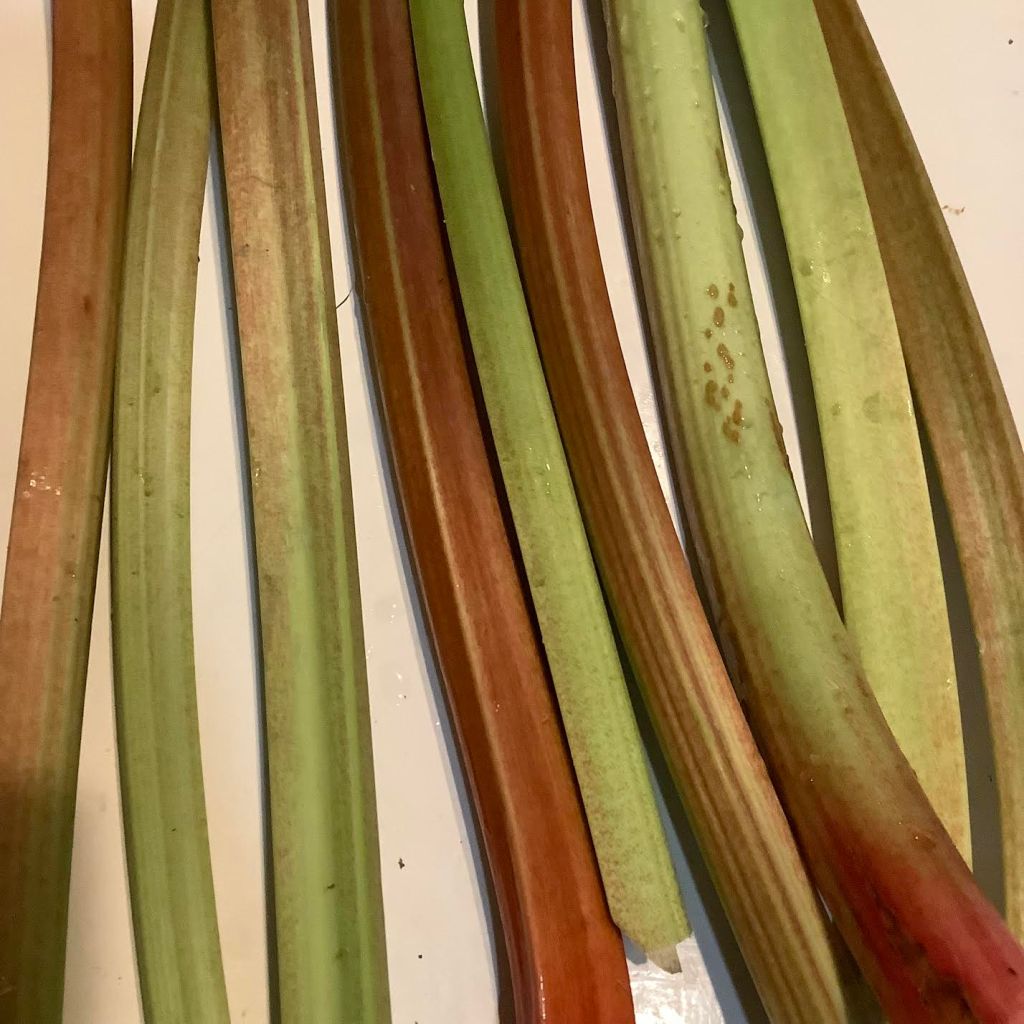
Rhubarb is a very hardy perennial plant, so tenacious that it will survive from growth zone 8 to zone 3. It is part of the Buckwheat Family [Polygonaceae] of plants, the cousin of sheep sorrel and curly dock [Rumex crispus]. Garden rhubarb in the United States is Rheum rhabarbarum, one of dozens of varieties within that Genus. The roots are long, woody, and look somewhat like huge carrots. They are referred to as ‘crowns.’ Around here, the Rhubarb starts to come up in April: a red, bud-like knob of curled leaf, crowning through the soil. Then come the stalks, pushing the leaves higher into the air. The stalks can be three feet tall, colored red or green. The leaf is heart-shaped and very wide. At this point, the stems can be harvested for eating. [What can one cook with rhubarb? Several future blogs will address that, recipes included.] Please note: although those leaves look good enough to eat, they contain high amounts of the toxin Oxalic Acid. DO NOT EAT THE LEAVES.
From the first pink buds pushing up, to the full leaf unfurling, it is a treat to watch the changes as the Rhubarb grows. photos from University of Wisconsin-Madison.
By June, the flower stalks rise high above the leaves, carrying bunches of tiny, frothy flowers looking like cumulus clouds. Gardeners in the know are aware that these stalks must be cut down. If a Rhubarb plant blooms, then the stalks become too tough and woody to eat. This has lead to the erroneous notion that Rhubarb is available only in the Spring. No so. If you cut down the flower stalks, you can harvest the stems until September.
At the Bennington New Hampshire Rhubarb Festival, there are contests for ‘Longest Stalk’ and ‘Widest Leaf,’ as well as ‘Rhubarb Photography’ and ‘Rhubarb Flower Arrangement.’
Rhubarb stalks come in many colors, which has no affect on the flavor or tartness.Rhubarb flowers can make a nice arrangement.
The next installment will be posted on May 9. If you click the Follow button, all future posts will be sent straight to your inbox every month.
In 2013, neighbors Janice and Molly decided to start a rhubarb celebration. Why? you might ask. They were looking for a fund-raising activity to benefit the town library’s building fund, and they thought that it was high time that there was a town fest of some sort. Rhubarb is the ‘first fruit of the season’ and by early June, the plant is up and thriving in gardens all over the region. No other town in the area had a Rhubarb Festival, so it had to be Rhubarb! After much planning, they held a bake sale on the Library Lawn in early June. The next year, a baking contest, a face-painter, craft sellers, a children’s Fun Run, and a basket raffle joined the bake sale. By 2020, the Town’s Recreation Committee was involved in the planning, but there was no Festival that year at all due to the Pandemic.
Busy Bake Table on the Library Lawn.Rhubarb Pies await the Judging.All sorts of fun at the Rhubarb Festival.
Resuming in 2021, the Festival had moved from the Library Lawn to a town ball-field to give us more room. Events began on Friday evening with live music, food trucks, and contest entries being delivered. Many more crafters, a petting-zoo, the Rhubarb Store, a Hollerin’ Contest, and Drink Your Rhubarb made the Festival larger and even more fun. The King Arthur Flour company sponsored the Pie Baking Contest — Rhubarb of course — and money was raised for the Library Building Fund from the sale of baked goods and books.
The Festival is still going strong and is always held on the first weekend of June, on Saturday, beginning at 10 am. This year will be our 10th anniversary. Plan to join us at Sawyer Park, Bennington, NH. If you would like to help out, please send your contact info to Rhubarb Committee, c/o G.E.P. Dodge Library . If you would like to help the Building Fund, please contribute any amount to the G.E.P. Dodge Library Building Fund.
The next installment will be posted on April 11. If you click the Follow button, all future posts will be sent straight to your inbox every month.