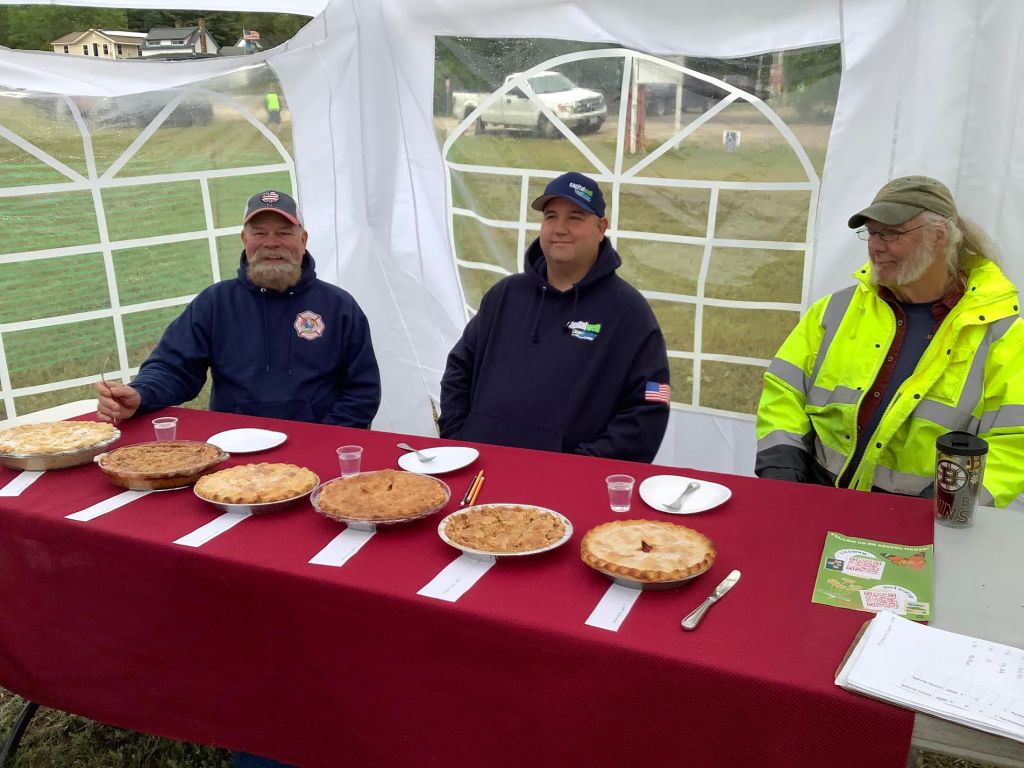
What a great time we had on June 1st at the Bennington Rhubarb Festival! There were vendors galore, food trucks and FABULOUS weather. There were 10 pies entered in the Baking Contest, and seven wines in the New England Rhubarb Wine Contest. Rhubarb-themed goods flew off the shelves of the Rhubarb General Store and a lot of people showed up to ‘Drink Rhubarb’. People came from as far away as Manchester, due to good mention in the press. Everything sold out at the Bake Table, and best of all, money was made for the G.E.P. Dodge Library Building Fund!
If you visit a medieval garden in England or France any time between Spring and Summer, you will see rhubarb amongst the plants being grown. Strictly speaking, rhubarb is not a true fruit but you will usually find it in or near the fruit section of the garden. It was grown as an ornamental plant.
Herb garden in the Middle Ages; a doctor selecting herbs for medicinal purposes. – Book illumination, c.1400. Illustration for ‘Roman de la Rose’. London, British Museum.
The English were perhaps the first people ever to taste rhubarb. Most probably it would have been wealthy merchants and aristocrats who travelled to Europe in the mid 1350’s. In terms of royalty, that could have included King Edward III of England who reigned from 1327 to 1377. Edward was not only the King of England but he also possessed the Duchy of Aquitaine in France. With many supporters there, he often travelled to France and had French family.
In medieval 14th century Europe, rhubarb was mainly used for medicinal purposes, commonly as a laxative. So a credible scenario for its consumption in medieval, aristocratic circles might have been a day or so following an over-indulgent medieval banquet when guests were suffering the after-effects of too much meat!
Much later the Italian explorer Marco Polo found a thriving trade in the leafy vegetable in Mongolia and China in the 13th century. The explorer found the plant, known in China as the “great yellow” – perhaps because of its thick yellowish roots – in the land of the Tangut people in Mongolia and in the far north of China, west of the present-day city of Beijing. “Over all the mountains of this province rhubarb is found in great abundance, and thither merchants come to buy it, and carry it thence all over the world,” he wrote.
Rhubarb became a highly sought-after and prohibitively expensive medicine in Europe. In France, by the 1500s, the root was 10 times as expensive as cinnamon and four times as expensive as saffron. The cost was high partly because it was imported via long caravan routes from the east via Turkey and Russia.
In the 1600s, Russia saw the value in establishing a valuable monopoly over the rhubarb trade in Europe, and breaking the monopoly was punishable by death. Emma Kay, a British food historian who founded the Museum of Kitchenalia in England’s Cotswolds area, says rhubarb was smuggled into Britain from Russia by a Scottish doctor called James Mounsey, who set up a practice in Moscow in the 1700s. The doctor treated both Russian Tsar Peter the Great and Catherine, Peter’s second wife and successor.
And that’s how Rhubarb arrived in Western Europe after centuries of exclusivity in its trade.
The Friday evening Preview was a wash-out — a squall came through with strong winds, hail, and torrential rains!! But through it all, the judges at the New England Rhubarb Wine Contest sipped and considered. They liked the Rhubarb Blush from Putney Mountain Winery in Vermont the best.
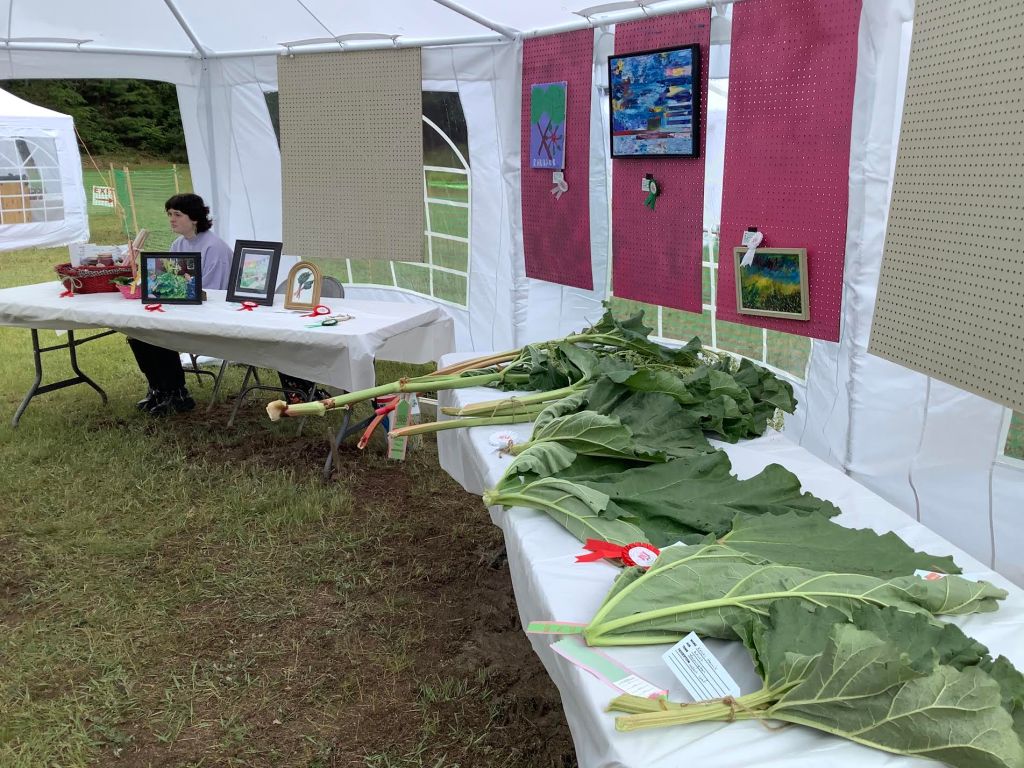
Saturday was cool and happily rain-free. The contest tent was full of long stalks and wide leaves, along with art work and flower arrangements.
The field was full of vendors and non-profit information booths. In the Drink Your Rhubarb tent, three ladies of Hartwick College sipped Rhubarb beverages contentedly. A good time was had by all.
The G.E.P. Dodge Library sold books and baked goods to inch us closer to renovations.
See you on the first weekend of June in 2024.
This is the blog of the Bennington Rhubarb Festival, started in 2013 to benefit the G.E.P. Dodge Library Building Fund.
If you would like to help the Building Fund, please contribute any amount to the G.E.P. Dodge Library Building Fund, Bennington, NH 03442.
The next blog installment will be posted on June 6, 2023. If you click the Follow button, all future posts will be sent straight to your inbox every month.




 benningtonnhRhubarbblog