In England, more so than the US, Rhubarb is eagerly anticipated in the Spring. The plant is grown commercially, especially in the Rhubarb Triangle of West Yorkshire and their singular product is ‘forced rhubarb.’ Forced to do what? you ask. I will explain.
The plants are grown in the fields for two years, just like all Rhubarb. In November, when they are dormant, the roots are transplanted into low heated sheds, protected from the weather. Months before the soil warms in the rest of the country, the Rhubarb begins to sprout. The sheds are completely dark, sometimes illuminated by red light bulbs or candles. In the warm, nitrogen-rich soil, the plants grow so fast that you can hear them!
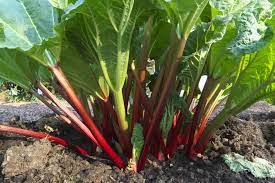
Forced Rhubarb with its bright red stalks and weird leaves.
Forcing Rhubarb makes it available for sale out of season. Thus it is in the markets from December to April. Forced Rhubarb leaves are pale green, due to a lack of chlorophyll from growing in the dark. The stalks are red. This product is prized for its sweetness [leading to the mistaken idea that red field-grown Rhubarb of any sort is sweeter than green Rhubarb], and its tenderness. After the last harvest, the plants are dug up and put in the compost pile.
This is the blog of the Bennington Rhubarb Festival. The Festival was started in 2013 to benefit the library Building Fund. If you would like to help the Building Fund, please contribute any amount to the G.E.P. Dodge Library Building Fund, Bennington, NH, 03442, USA.
The next installment of this blog will be posted on May 7, 2024. If you click the Subscribe button, all future posts will be sent straight to your inbox every month.
June 1, 2024, will see the Bennington Rhubarb Festival in full swing at Sawyer Park, Bennington, New Hampshire. This year, the Library Trustees are running the Festival and many of the favorite elements of the event will be present: Pie and Bake Sale, Rhubarb Pie Contest, Rhubarb Store, Petting Zoo, Children’s Activity Tent, Story Walk, vendors, food, music, Rhubarb superlative contests, art contest, flower arrangements.
The Festival will open at 10 am and close at 3 pm at Sawyer Park, just off Route 202, behind ‘Harris’ Store’. Parking is free. Admission is free.
Can you see them — those pink leaf buds pushing up through the soil? This is the earliest that I can remember seeing new growth, a full three weeks before last year. [Don’t try to tell me that the climate isn’t changing!] Usually the Rhubarb Patch is covered by at least a foot of snow in mid-March, but we had a mild winter.
As the leaves unfurl and the stalks grow taller, it is time to watch for flower buds. It is good to locate those early. Why? I like to dig out the roots that are flowering, to thin out the bed. The roots that are removed are sold to benefit the Library Building Fund or moved to another part of the garden where they will have more room.
Can Rhubarb Pie be far behind? Yum.
This is the blog of the Bennington Rhubarb Festival. The Festival started in 2013 to benefit the G.E.P. Dodge Library Building Fund.
If you would like to help the Building Fund, please contribute any amount to the G.E.P. Dodge Library Building Fund, Bennington, NH 03442.
The next blog installment will be posted on April 9, 2024. If you click the Subscribe button, all future posts will be sent straight to your inbox every month.
Rhubarb is not only for dessert! Its tartness pairs well with all sorts of foods, from beef to turkey to pork to meat. And then there is fish: in France and England, it is typical to pair tart fruits with ‘fatty’ fish such as mackerel and salmon. The first time I sold this relish at the Rhubarb Festival’s “Rhubarb Store”, the attendants bought a jar and ate it on hot dogs from a vendor. They proclaimed it to be ‘the BEST!” and they bought some more.
Halibut topped with Rhubarb-Onion Relish is served with asparagus and farro.
This delicious condiment appears in Marion Cunningham’s, The Supper Book. The author recommends serving the relish cold on hot meat.
Rhubarb-Onion Relishmakes 3 cups
2 c rhubarb, chopped 2 c. onions, chopped 1 c. vinegar 1 ½ tsp salt 2 c. light-brown sugar ½ tsp ground cloves ½ tsp ground allspice ½ tsp ground cinnamon
Combine everything in a heavy pot. Heat to a boil, turn down to a simmer. Cook 45 minutes until thicker. Put into jars and cool before twisting on the lids. Fresh, it will keep in the ‘frige for a week.
For longer storage, spoon hot relish into canning jars [I like to use the 1/2-cup size for relishes] with 2-part lids and process in a hot water bath 15 minutes.
This is the blog of the Bennington Rhubarb Festival. The Festival was begun in 2013 to benefit the G.E.P. Dodge Library Building Fund.
If you would like to help the Building Fund, please contribute any amount to the G.E.P. Dodge Library Building Fund, Bennington, NH 03442.
The next blog installment will be posted on April 9, 2024. If you click the Subscribe button, all future posts will be sent straight to your inbox every month.
We love rhubarb. At our house, pies and muffins and coffee cakes go into the freezer every Spring and Summer, to last into the Winter. This is one of our favorite coffee cakes, adapted from a recipe in the New York Times. Get the family involved: one person prepares the crumb, another prepares the wet mixture. One person prepares the batter, another prepares the fruit. Then everyone helps to assemble it for baking and everyone enjoys eating it!
A perfect Sunday breakfast with fruited yogurt and chicken sausages.
Preheat oven to 325 F. Butter a 9” springform pan. Serves 12-16
for the CRUMB: 1/3 cup dark brown sugar + 1/3 cup granulated sugar 1 teaspoon ground cinnamon + ½ teaspoon ground ginger 1/8 teaspoon salt + ½ cup/1 stick butter, melted ¾ cup all-purpose flour + 1 cup white whole wheat flour In a large bowl, whisk sugars, spices and salt into melted butter until smooth. Add flour and stir with a wooden spoon. It will look and feel like a solid dough. Leave it pressed together in the bottom of the bowl. Set aside THE CRUMB.
For the FRUIT: 16 oz [1#] rhubarb, sliced ½-inch thick ¼ cup sugar + 2 tsp cornstarch + ¾ tsp ground ginger Toss these ingredients together. Set aside THE FRUIT.
for the WET mixture: 1/3 cup plain yogurt OR sour cream 1 US Large [2 oz] egg + 1 egg yolk from a US Large egg 2 tsp vanilla extract In a small bowl, stir these ingredients together to form the ‘Wet Mixture.’ Set aside THE WET MIXTURE
for the BATTER: ½ cup all-purpose flour ½ cup white whole wheat flour + ¼ tsp salt 1/3 cup sugar + ½ tsp baking soda + ½ tsp baking powder Using a mixer fitted with paddle attachment, mix these ingredients together. 6 Tbsp softened butter + 1 Tbsp of above Wet Mixture Cut butter into 12 pieces. Add these to above. Mix on medium speed ’til flour is moistened. Increase speed, beat 30 seconds. ½ of Wet Mixture = 3 oz other ½ of Wet Mixture = 3 oz Add Wet Mixture in 2 batches, beating 20 secs after each addition, scraping down sides of bowl. Pour batter into pan.
to ASSEMBLE: Spoon rhubarb over batter. With your fingers, break/squeeze crumb mixture into big crumbs, ~½” -¾” in size. Sprinkle over rhubarb and cake.
Bake 45-55 min until a toothpick inserted into center comes out clean (it might be moist from rhubarb). Cool ~10 mins, then remove collar of pan. Cool completely before serving.
This is the blog of the Bennington Rhubarb Festival, started in 2013 to benefit the G.E.P. Dodge Library Building Fund.
If you would like to help the Building Fund, please contribute any amount to the G.E.P. Dodge Library Building Fund, Bennington, NH 03442.
The next blog installment will be posted on March 12, 2024. If you click the ‘Subscribe’ button, all future posts will be sent straight to your inbox every month for free.
Some families like to play games together during the holidays. But Monopoly takes forever and Scrabble is not for everybody. How about introducing Rhubarb Trivia to the fun? Print up this fact sheet and distribute it so people can study. Then hold a contest. Winner gets an extra helping of Rhubarb Pie or Rhubarb Pudding or Rhubarb Crumble Bars. At last year’s Rhubarb Festival, there was a Trivia Contest — get ready for Festival 2024!
How many species of rhubarb are there?
19
What is the coldest growth zone in which rhubarb will thrive?
Zone 2
What common grain shares a family with rhubarb?
Buckwheat
What is the Genus name of rhubarb?
Rheum
How tall can Rheum officinale [garden rhubarb] grow?
2 meters = 6.5 feet
How many calories in 2/3 cup of rhubarb?
20
What part of the rhubarb plant should you never eat?
leaves
What toxin is in rhubarb leaves?
Oxalic acid
Rhubarb is high in what vitamin?
Vitamin K1
What do you do to a rhubarb plant to be able to harvest it all summer long?
Cut off the flower stalks
How long can a rhubarb plant live?
60+ years
Which soil nutrient does rhubarb love the best?
Nitrogen
Where is the origin of rhubarb?
Central Asia.
Which ancient Asian civilization believed that the first humans grew from a rhubarb plant?
Persia
Which of these ancient civilizations used Rhubarb? Indus River or Mayan or Roman
Indus River
This is the blog of the Bennington Rhubarb Festival, which was started in 2013 to benefit the library Building Fund. If you would like to help the Building Fund, please contribute any amount to the G.E.P. Dodge Library Building Fund, Bennington, NH, 03442, USA.
The next installment of this blog will be posted on January 16, 2024. If you click the Follow button, all future posts will be sent straight to your inbox every month.
Want the taste of Rhubarb Pie without the fuss of a pie crust? For the crust-averse, nothing beats a pan of Rhubarb Crumble Bars!
I dare say there are many variations on this recipe [called Rhubarb Crunch, Rhubarb Bars, et al], but mine is from a cookbook compiled in 1976. That year the nation was celebrating its bicentennial, and many women’s groups put out a cookbook to mark the occasion. One such was the Carlisle Junior Civic Club, in Carlisle, Pennsylvania where my parents lived. This is the recipe of Mrs K.E. Gephart, Sr for her Rhubarb Crunch:
Mrs. Gephart said, “This is a different way to prepare rhubarb and much better than rhubarb pie!”
9” square pan, 8-9 servings
9×13” pan, 18-24 servings
Set oven to 350F
1 c. sifted flour ¾ c uncooked rolled oats 1 c brown sugar, packed ½ c/1 stick butter, melted 1 tsp cinnamon
2 c. white whole wheat flour 1½ c. uncooked rolled oats 1½ c brown sugar, packed 1 c/2 sticks butter, melted 2 tsp cinnamon
Mix together until crumbly. Divide mixture in two equal portions. Pat ½ of mixture into a greased pan.
4 c. diced rhubarb
8 c. diced rhubarb
Distribute evenly over crumbs.
1 c. sugar 2 Tbsp cornstarch 1 c. water 1 tsp vanilla extract
1½ c. sugar 3 Tbsp cornstarch 1½ c. water 2 tsp vanilla extract
Combine these in a small pan. Cook, stirring, ’til thick and clear. Pour over rhubarb in pan.
½ crumb mixture
½ crumb mixture
Distribute evenly over rhubarb.
Bake 45-60 mins until bubbly.
Whipped cream
Whipped cream OR ice cream
Cool briefly, cut in squares. Serve plain or with topping.
This is the blog of the Bennington Rhubarb Festival. The festival started in 2013 to benefit the G.E.P. Dodge Library Building Fund and all things Rhubarby.
If you would like to help the Building Fund, please contribute any amount to the G.E.P. Dodge Library Building Fund, Bennington, NH 03442.
The Blog is published monthly. Press the Follow button to have them delivered straight to your inbox.
Rhubarb, Rheum rhabarbarum, originated in southern Siberia, on the border with Mongolia. Some say the name is of latin origin — yet the Greeks were using it for medicine before Roman times, and they called it rheon, which is related to a Persian word for the plant. The ‘barberum’ part of the name means ‘foreign.’
The Genus name ‘Rheum,’ comes from central Asia’s Rha River, named by the Scythians, now called the Volga River. The region has been inhabited for 9000 years, but at what point the inhabitants began to use Rhubarb or even how it arrived there from Siberia, we can only speculate. They must have grown a lot of rhubarb in the Volga floodplain, facilitated by the well-drained fluvial sediments with a high organic content. Thus, Rhubarb means ‘foreigner’s plant from the Rha River Valley.’
As long ago as 5000 years ago, the Chinese used the woody roots of Rheum palmatum for medicine: to relieve diarrhea, fevers, and constipation. [Constipation was a frequent problem in days past, due to the unavailability of fresh fruits and vegetables for months at a time.] Medicines that promoted bowel function were called ‘cathartic’ or ‘purgative.’
Along the Silk Road, formalized in 130 BCE, rhubarb roots were traded widely. Their laxative properties were in high demand and rhubarb roots were the major export of Asia for centuries — a very valuable commodity. Rhubarb in those days was not valued for the stalks, but for the roots only. Thus from the very early days, Rhubarb was a useful medicine and a valuable commodity.
This is the blog of the Bennington Rhubarb Festival, which was started in 2013 to benefit the library Building Fund. If you would like to help the Building Fund, please contribute any amount to the G.E.P. Dodge Library Building Fund, Bennington, NH, 03442, USA.
The next installment of this blog will be posted on November 21, 2023. If you click the Follow button, all future posts will be sent straight to your inbox every month.
You can plant or transplant Rhubarb in Spring, Summer, or Fall. Most garden centers and catalogues offer Rhubarb root-stock only in the Spring, but if your neighbor decides to share some with you in August, then it is time to plant! Nor is it too late in October, as long as the ground is not frozen. Our current bed was put in place right before a July heat spell, and it has thrived ever since.
What about planting from seeds? you ask. You could do that, but it will take several years for the plants to mature sufficiently to give you enough Rhubarb to use. Root-stock is easy to plant and yields a quicker result.
Choose a location that will get full sun, preferably with sandy soil for drainage. If your soil is too clayey, plant in a raised bed. Dig a large, deep hole — deeper than the roots are long. Put some high-Nitrogen manure [horse-with-straw, cow-with-straw, chicken-with-wood-shavings] in the hole, then pour in some water. Put the root into the ground so that the top of the root, where the leaves come out, two inches lower than soil level. Add some soil and lightly pack it around the root so it will stand up-right. Add more soil until it is just buried, then pour over it about a gallon of water. Top dress with more manure. If you have multiple roots to plant, space them 3 feet apart, only one root per hole.
If you lack space for a dedicated Rhubarb Patch, tuck it into a flower bed — Rhubarb was once used as a decorative plant in England. Just be sure that the Rhubarb has lots of room [a mature clump can be 4′ across].
The next Spring, watch to see if your babies come up. Be patient, they might be a bit sluggish the first year. Resist the urge to harvest any stalks the first year — let the plants get settled in their new home first. In the late Fall, once the leaves have died back, top dress the area with liberal amounts of manure. I use three 30-gallon barrels to feed a 16-clump garden measuring 15’x15′. Does that sound excessive? Does this explain why my Rhubarb patch is extremely lush and luxuriant? I’m lucky: our chickens keep us very well supplied with copious amounts of manure-in-shavings.
The 2nd Spring after planting, each root is getting established and you might harvest one stalk from each crown. If you have only a few stalks, make some Rhubarb-Walnut Muffins. If you have a lot, make a pie. Don’t forget to add manure in the Fall. Unless you are having a terrible drought, you do not have to water rhubarb in the Summer.
The 3rd Spring after planting, harvest at will. If a crown has three stalks, harvest one, from the outside. It will produce more. If a crown has five stalks, harvest two — again from the outside. Always leave most of the stalks on the plant — the leaves are making food and sending it to the roots to get the plant through the Winter. Each Fall, top dress with manure again.
At some point in the plant’s life, the clumps will get over-crowded. That’s when they bloom. If you want Rhubarb all Summer long, cut off the flower stalks and make a flower arrangement. Do not let the plants bloom or set seed, lest the stalks become woody and unusable.
Rhubarb is over-looked as a fruit in muffins. Why, I wonder. This muffin recipe is a favorite in our household. The recipe is very easy to prepare and the baked muffins freeze well. If you have only a few stalks of Rhubarb, not enough for a pie or other recipe, here is your solution. Unfortunately, I do not know where I got this recipe — wish I could give credit.
Rhubarb-Walnut Muffins
12 standard muffins/ 16-18 if using silicon cup-liners
Preheat oven to 350F
1½ c white whole wheat flour +++1¼ c white flour 1½ tsp baking powder+++ ½ tsp baking soda
Whisk together
1½ c diced rhubarb +++½ c. chopped walnuts or pecans
Add to dry ingredients and stir well to incorporate.
2/3 c vegetable oil +++¾ c brown sugar+++2 US large eggs = 2 oz each 1/3 c white sugar
Beat together until light.
1 c milk 1 tsp vanilla
Add to egg mixture and stir in. Add to dry ingredients and combine thoroughly.
Divide among muffin tins or liners
Bake ~15 mins or until toothpick tests well.
This is the blog of the Bennington Rhubarb Festival. The festival started in 2013 to benefit the G.E.P. Dodge Library Building Fund and all things Rhubarby.
If you would like to help the Building Fund, please contribute any amount to the G.E.P. Dodge Library Building Fund, Bennington, NH 03442.
The next blog installment will be posted on September 26, 2023. If you click the Follow button, all future posts will be sent straight to your inbox every month.




 benningtonnhRhubarbblog