Wine from grapes has been produced and enjoyed for millennia. Wine from other fruits, called ‘country wines‘ have probably been produced for just as long. Rhubarb, although not a ‘fruit,’ makes a very pleasant wine. In the past, country wines were often sweet, but that does not have to be the case. Rhubarb wines can be dry or off-dry as you wish.
At the Bennington Rhubarb Festival in 2019, we introduced a competition for New England Rhubarb Wines — open to professional and amateur wine makers. The contest went on hiatus during the Pandemic and came back this year for the 2nd time. Although there has been a revival of country wine making in Northern New England, very few of the vintners in Maine, New Hampshire, and Vermont produce a rhubarb wine. The state that makes the most rhubarb wine is North Dakota.
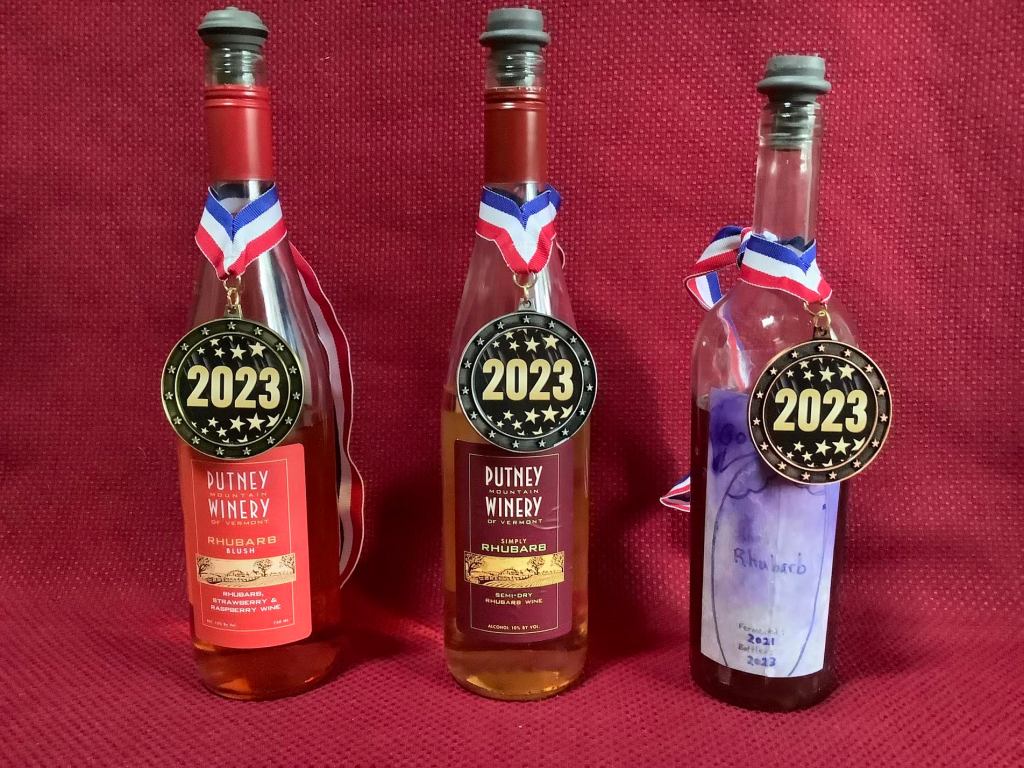
Try making your own Rhubarb Wine! If you live in New England, enter it in next year’s competition. The recipe that I prefer is from First Steps in Winemaking, by C.J.J. Berry. This looks long and complicated, but most of the effort is in short spurts and the rest of the time the wine is ‘working’ or ‘resting.
Equipment:
- cheesecloth or a jelly bag
- plastic bucket with 2-gallon volume and a lid
- large collander [to fit within the plastic bucket]
- large bowl or pot, larger than 1 gallon
- hydrometer and cylinder for using it
- Camden tablets + Citric Acid, to make sterilyzing solution
- 2 one-gallon glass jugs [think jug wine]
- 6 standard 750 ml wine bottles [one for now, 5 for later]
- funnel which fits inside a wine bottle
- 1 jug-stopper air lock
- 1 wine-stopper air lock
- 5-6 new wine corks
- corking machine or rubber mallet
Ingredients to make 1 US gallon = five 750 ml wine bottles:
- 2½ pounds rhubarb stalks 2 pounds sugar
- 1 gallon water
- 250 ml white grape concentrate
- 1 tsp yeast nutrient
- ½ tsp pectic enzyme
- 2 tsp wine yeast
| Day 1 | *Camden Solution *Rhubarb, cut in 1” pieces *Sugar | Put the rhubarb and sugar put in a sterilized plastic bucket with a lid. Let sit around 24 hours, until most of the sugar is dissolved. The rhubarb will give off some liquid. |
| Day 2 | *Large bowl/pot of 1-2 gallons in volume *Collander *1 gallon water *250 ml [1 cup] white grape concentrate | Mark the side of the large bowl or pot so you know where it holds 1 gallon of volume. Pour fruit/sugar into a collander over the bowl/pot. There will still be some sugar in the bucket, so pour some water into the plastic bucket and swirl around. Pour the sugar water over the rhubarb and sugar in collander. Keep pouring water over the fruit to wash the sugar and rhubarb juice from the fruit. YOU MIGHT NOT USE ALL OF THE GALLON OF WATER, due to melted sugar and rhubarb juices. Now you have left-over rhubarb for cooking – suitable for a pie or coffeecake, but not for jam/jelly since it is an unpalatable color. Stop adding water when there is 1 gallon of water/sugar/juice in the bowl. Pour sugar-water back into the plastic bucket. Add grape concentrate to the water in the bucket. |
| Day 2 | *1 tsp yeast nutrient *½ tsp pectic enzyme *2 tsp white wine yeast | AT THIS POINT, USE THE HYDROMETER TO DETERMINE THE SPECIFIC GRAVITY. Write it down. Add nutrient, enzyme, and yeast to plastic bucket. Cover the bucket. |
| Day 3 | Let sit for 8-24 hours, until it starts to bubble. Little bubbles, not a ‘full rolling boil.’ | |
| Day 4 | *Camden Solution *1 gallon glass jug *sterilized wine bottle *air-lock for each vessel | Pour wine into a sterilized 1 gallon glass jug.Fill up to 1” below the neck, not to top of the bottle.If you have extra wine, pour it into a sterilized wine bottle so that the wine fills at least half of the bottle.Put airlocks on the jug and the bottle. Label the vessels.Put aside in a dark place that is cooler than room temperature but not cold. Let it sit for 3 months. |
| Three Months | Sterilized jug | There will be some sludgy-looking stuff [dead yeast and fine sediment, called ‘lees’] on the bottom of the bottles. Sterilize another jug and pour the wine carefully into the new jug so that the lees stay in the old jug. Pour the lees down the drain – it is very good for the septic tank! Top off the large jug with wine from the other bottle. |
| 6-12 Months | *Flashlight *hydrometer *Sugar syrup [simple syrup] | Check to see if the wine has cleared: Shine a flashlight through it. If it looks cloudy, continue to let it sit. When wine is clear, pour it off into a sterilized jug as before. USE HYDROMETER TO TEST SPECIFIC GRAVITY. IT SHOULD FLOAT AT 1.000. IF IT FLOATS LOWER, ADD SOME SIMPLE SYRUP. IF IT FLOATS HIGHER, LET IT SIT LONGER OR ADD A LITTLE WATER. |
| Taste a bit of the wine to see if it to your liking. Add simple syrup a bit at a time to improve the taste. DO NOT ADD TOO MUCH OR THE WINE WILL REFERMENT AND YOUR CORKS WILL POP OFF, SPILLING THE WINE. | ||
| *Camden Solution *5-6 standard wine bottles *funnel small enough to fit in the neck of the bottles *5-6 new wine corks-*wine corking machine or rubber mallet | Wash and sterilize 5-6 standard wine bottles. Sterilize the funnel. Boil some water, take off heat and submerge corks in the water for no more than 10 minutes. Remove from water and keep on a plate covered with a lid. Pour wine into each bottle until 2-3” below top of bottle. Dip each cork in Camden Solution, then using the corker or mallet, put the cork fully into each bottle. | |
| Label the bottles with the name and date of the wine. Lay bottles on their side in a cool place for one or more years to age and improve before drinking. |
This is the blog of the Bennington Rhubarb Festival, which was started in 2013 to benefit the library Building Fund. If you would like to help the Building Fund, please contribute any amount to the G.E.P. Dodge Library Building Fund, Bennington, NH, 03442, USA.
The next installment of this blog will be posted on 29 August 2023. If you click the Follow button, all future posts will be sent straight to your inbox every month.






 benningtonnhRhubarbblog