Rhubarb clumps/crowns expand by adding on to the roots at the edges. You plant one single root [crown], and in a few years there are more stalks coming up at the sides. Eventually the initial root is at the center of a huge clump, and the roots at the center are feeling crowded.
Crowded Rhubarbs produce flowers [they have to be cut off before they bloom, remember?], which is an energy drain for them. The thing to do when they get crowded is to divide the clump. You could do it when you see the flower stalks rising up out of the patch, but the better time for dividing is early in the season, before the leaves and petioles/stalks become too large.
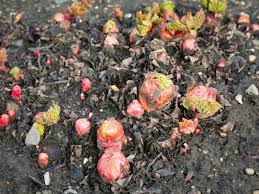
How can you tell which clumps to divide? IN SPRING: Look among the young leaves for giant buds. They start off encased in reddish membrane, then turn into swollen buds. When you identify those huge buds — even when the stalks have barely grown — you have found parts of the clump that need to be cut out. These might be in the middle of the clump or even around the edges.
IN FALL: You will have forgotten which clumps bloomed last May, but the stalks where you cut off the flowers remain. They are hollow and easy to spot. Dig there to divide. If there are leaf stalks [called petioles] still growing from the root, harvest them now so the plant can save energy. Use those late-season stalks for pies or cut them, put in zipper bags, and freeze.
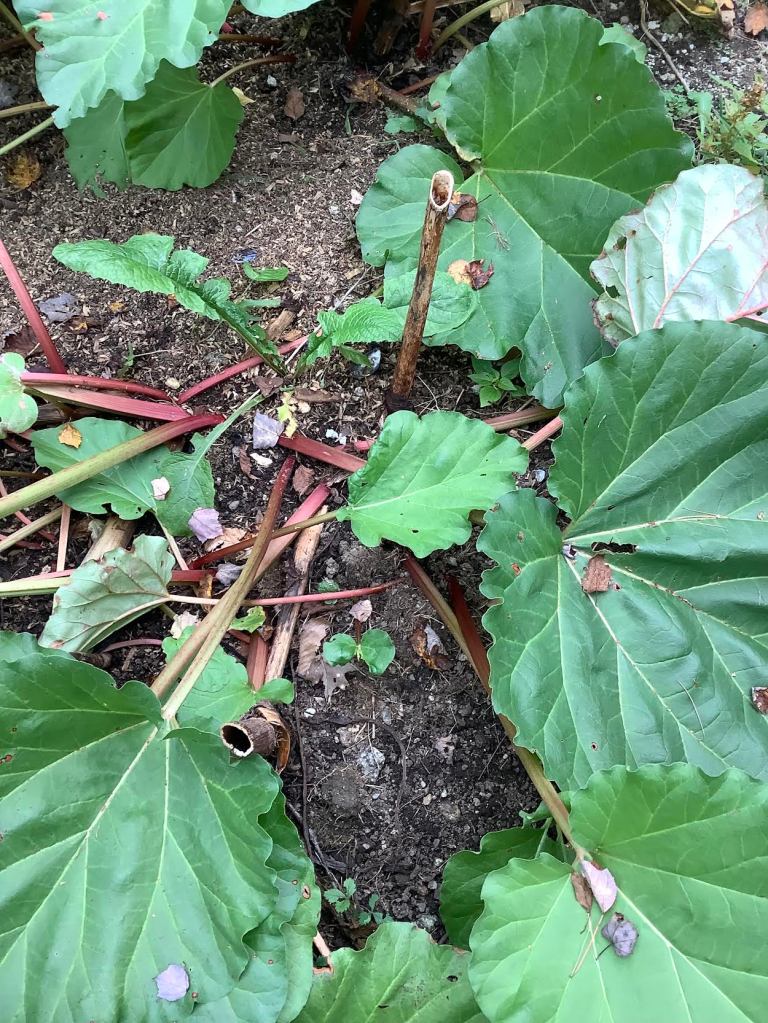
Dig holes ready to receive the new roots, and have a bucket of water handy. With a stout shovel or spade, slice into the root ball between leaf clusters. Make thrusts on three sides [four if you can] around the root that you want to raise, then gently pry it up. This may take some practice, but do what works for you.
Pour water into the hole that is ready to receive the roots, and let it sink into the soil. Position the freshly-dug root in the hole. Add some well-rotted manure to fill the hole half-way. Top with soil until the root is buried up to its neck. Tamp down the soil with your boot, add more soil if needed, building up the soil so the crown is in a bit of a well. Pour water over the soil to help it settle. Heap more manure around the future clump.
If you don’t have room in your garden to plant the crowns you dug, share them with a friend. Remember that one of Rhubarb’s nicknames is “The Neighbor Plant”.
This is the blog of the Bennington Rhubarb Festival, started in 2013 to benefit the G.E.P. Dodge Library Building Fund.
If you would like to help the Building Fund, please contribute any amount to the G.E.P. Dodge Library Building Fund, Bennington, NH 03442.
The next blog installment will be posted in November, 2026. If you click the Follow button, all future posts will be sent straight to your inbox every month.

