Some families like to play games together during the holidays. But Monopoly takes forever and Scrabble is not for everybody. How about introducing Rhubarb Trivia to the fun? Print up this fact sheet and distribute it so people can study. Then hold a contest. Winner gets an extra helping of Rhubarb Pie or Rhubarb Pudding or Rhubarb Crumble Bars. At last year’s Rhubarb Festival, there was a Trivia Contest — get ready for Festival 2024!
How many species of rhubarb are there?
19
What is the coldest growth zone in which rhubarb will thrive?
Zone 2
What common grain shares a family with rhubarb?
Buckwheat
What is the Genus name of rhubarb?
Rheum
How tall can Rheum officinale [garden rhubarb] grow?
2 meters = 6.5 feet
How many calories in 2/3 cup of rhubarb?
20
What part of the rhubarb plant should you never eat?
leaves
What toxin is in rhubarb leaves?
Oxalic acid
Rhubarb is high in what vitamin?
Vitamin K1
What do you do to a rhubarb plant to be able to harvest it all summer long?
Cut off the flower stalks
How long can a rhubarb plant live?
60+ years
Which soil nutrient does rhubarb love the best?
Nitrogen
Where is the origin of rhubarb?
Central Asia.
Which ancient Asian civilization believed that the first humans grew from a rhubarb plant?
Persia
Which of these ancient civilizations used Rhubarb? Indus River or Mayan or Roman
Indus River
This is the blog of the Bennington Rhubarb Festival, which was started in 2013 to benefit the library Building Fund. If you would like to help the Building Fund, please contribute any amount to the G.E.P. Dodge Library Building Fund, Bennington, NH, 03442, USA.
The next installment of this blog will be posted on January 16, 2024. If you click the Follow button, all future posts will be sent straight to your inbox every month.
Want the taste of Rhubarb Pie without the fuss of a pie crust? For the crust-averse, nothing beats a pan of Rhubarb Crumble Bars!
I dare say there are many variations on this recipe [called Rhubarb Crunch, Rhubarb Bars, et al], but mine is from a cookbook compiled in 1976. That year the nation was celebrating its bicentennial, and many women’s groups put out a cookbook to mark the occasion. One such was the Carlisle Junior Civic Club, in Carlisle, Pennsylvania where my parents lived. This is the recipe of Mrs K.E. Gephart, Sr for her Rhubarb Crunch:
Mrs. Gephart said, “This is a different way to prepare rhubarb and much better than rhubarb pie!”
9” square pan, 8-9 servings
9×13” pan, 18-24 servings
Set oven to 350F
1 c. sifted flour ¾ c uncooked rolled oats 1 c brown sugar, packed ½ c/1 stick butter, melted 1 tsp cinnamon
2 c. white whole wheat flour 1½ c. uncooked rolled oats 1½ c brown sugar, packed 1 c/2 sticks butter, melted 2 tsp cinnamon
Mix together until crumbly. Divide mixture in two equal portions. Pat ½ of mixture into a greased pan.
4 c. diced rhubarb
8 c. diced rhubarb
Distribute evenly over crumbs.
1 c. sugar 2 Tbsp cornstarch 1 c. water 1 tsp vanilla extract
1½ c. sugar 3 Tbsp cornstarch 1½ c. water 2 tsp vanilla extract
Combine these in a small pan. Cook, stirring, ’til thick and clear. Pour over rhubarb in pan.
½ crumb mixture
½ crumb mixture
Distribute evenly over rhubarb.
Bake 45-60 mins until bubbly.
Whipped cream
Whipped cream OR ice cream
Cool briefly, cut in squares. Serve plain or with topping.
This is the blog of the Bennington Rhubarb Festival. The festival started in 2013 to benefit the G.E.P. Dodge Library Building Fund and all things Rhubarby.
If you would like to help the Building Fund, please contribute any amount to the G.E.P. Dodge Library Building Fund, Bennington, NH 03442.
The Blog is published monthly. Press the Follow button to have them delivered straight to your inbox.
Rhubarb, Rheum rhabarbarum, originated in southern Siberia, on the border with Mongolia. Some say the name is of latin origin — yet the Greeks were using it for medicine before Roman times, and they called it rheon, which is related to a Persian word for the plant. The ‘barberum’ part of the name means ‘foreign.’
The Genus name ‘Rheum,’ comes from central Asia’s Rha River, named by the Scythians, now called the Volga River. The region has been inhabited for 9000 years, but at what point the inhabitants began to use Rhubarb or even how it arrived there from Siberia, we can only speculate. They must have grown a lot of rhubarb in the Volga floodplain, facilitated by the well-drained fluvial sediments with a high organic content. Thus, Rhubarb means ‘foreigner’s plant from the Rha River Valley.’
As long ago as 5000 years ago, the Chinese used the woody roots of Rheum palmatum for medicine: to relieve diarrhea, fevers, and constipation. [Constipation was a frequent problem in days past, due to the unavailability of fresh fruits and vegetables for months at a time.] Medicines that promoted bowel function were called ‘cathartic’ or ‘purgative.’
Along the Silk Road, formalized in 130 BCE, rhubarb roots were traded widely. Their laxative properties were in high demand and rhubarb roots were the major export of Asia for centuries — a very valuable commodity. Rhubarb in those days was not valued for the stalks, but for the roots only. Thus from the very early days, Rhubarb was a useful medicine and a valuable commodity.
This is the blog of the Bennington Rhubarb Festival, which was started in 2013 to benefit the library Building Fund. If you would like to help the Building Fund, please contribute any amount to the G.E.P. Dodge Library Building Fund, Bennington, NH, 03442, USA.
The next installment of this blog will be posted on November 21, 2023. If you click the Follow button, all future posts will be sent straight to your inbox every month.
You can plant or transplant Rhubarb in Spring, Summer, or Fall. Most garden centers and catalogues offer Rhubarb root-stock only in the Spring, but if your neighbor decides to share some with you in August, then it is time to plant! Nor is it too late in October, as long as the ground is not frozen. Our current bed was put in place right before a July heat spell, and it has thrived ever since.
What about planting from seeds? you ask. You could do that, but it will take several years for the plants to mature sufficiently to give you enough Rhubarb to use. Root-stock is easy to plant and yields a quicker result.
Choose a location that will get full sun, preferably with sandy soil for drainage. If your soil is too clayey, plant in a raised bed. Dig a large, deep hole — deeper than the roots are long. Put some high-Nitrogen manure [horse-with-straw, cow-with-straw, chicken-with-wood-shavings] in the hole, then pour in some water. Put the root into the ground so that the top of the root, where the leaves come out, two inches lower than soil level. Add some soil and lightly pack it around the root so it will stand up-right. Add more soil until it is just buried, then pour over it about a gallon of water. Top dress with more manure. If you have multiple roots to plant, space them 3 feet apart, only one root per hole.
If you lack space for a dedicated Rhubarb Patch, tuck it into a flower bed — Rhubarb was once used as a decorative plant in England. Just be sure that the Rhubarb has lots of room [a mature clump can be 4′ across].
The next Spring, watch to see if your babies come up. Be patient, they might be a bit sluggish the first year. Resist the urge to harvest any stalks the first year — let the plants get settled in their new home first. In the late Fall, once the leaves have died back, top dress the area with liberal amounts of manure. I use three 30-gallon barrels to feed a 16-clump garden measuring 15’x15′. Does that sound excessive? Does this explain why my Rhubarb patch is extremely lush and luxuriant? I’m lucky: our chickens keep us very well supplied with copious amounts of manure-in-shavings.
The 2nd Spring after planting, each root is getting established and you might harvest one stalk from each crown. If you have only a few stalks, make some Rhubarb-Walnut Muffins. If you have a lot, make a pie. Don’t forget to add manure in the Fall. Unless you are having a terrible drought, you do not have to water rhubarb in the Summer.
The 3rd Spring after planting, harvest at will. If a crown has three stalks, harvest one, from the outside. It will produce more. If a crown has five stalks, harvest two — again from the outside. Always leave most of the stalks on the plant — the leaves are making food and sending it to the roots to get the plant through the Winter. Each Fall, top dress with manure again.
At some point in the plant’s life, the clumps will get over-crowded. That’s when they bloom. If you want Rhubarb all Summer long, cut off the flower stalks and make a flower arrangement. Do not let the plants bloom or set seed, lest the stalks become woody and unusable.
Rhubarb is over-looked as a fruit in muffins. Why, I wonder. This muffin recipe is a favorite in our household. The recipe is very easy to prepare and the baked muffins freeze well. If you have only a few stalks of Rhubarb, not enough for a pie or other recipe, here is your solution. Unfortunately, I do not know where I got this recipe — wish I could give credit.
Rhubarb-Walnut Muffins
12 standard muffins/ 16-18 if using silicon cup-liners
Preheat oven to 350F
1½ c white whole wheat flour +++1¼ c white flour 1½ tsp baking powder+++ ½ tsp baking soda
Whisk together
1½ c diced rhubarb +++½ c. chopped walnuts or pecans
Add to dry ingredients and stir well to incorporate.
2/3 c vegetable oil +++¾ c brown sugar+++2 US large eggs = 2 oz each 1/3 c white sugar
Beat together until light.
1 c milk 1 tsp vanilla
Add to egg mixture and stir in. Add to dry ingredients and combine thoroughly.
Divide among muffin tins or liners
Bake ~15 mins or until toothpick tests well.
This is the blog of the Bennington Rhubarb Festival. The festival started in 2013 to benefit the G.E.P. Dodge Library Building Fund and all things Rhubarby.
If you would like to help the Building Fund, please contribute any amount to the G.E.P. Dodge Library Building Fund, Bennington, NH 03442.
The next blog installment will be posted on September 26, 2023. If you click the Follow button, all future posts will be sent straight to your inbox every month.
Wine from grapes has been produced and enjoyed for millennia. Wine from other fruits, called ‘country wines‘ have probably been produced for just as long. Rhubarb, although not a ‘fruit,’ makes a very pleasant wine. In the past, country wines were often sweet, but that does not have to be the case. Rhubarb wines can be dry or off-dry as you wish.
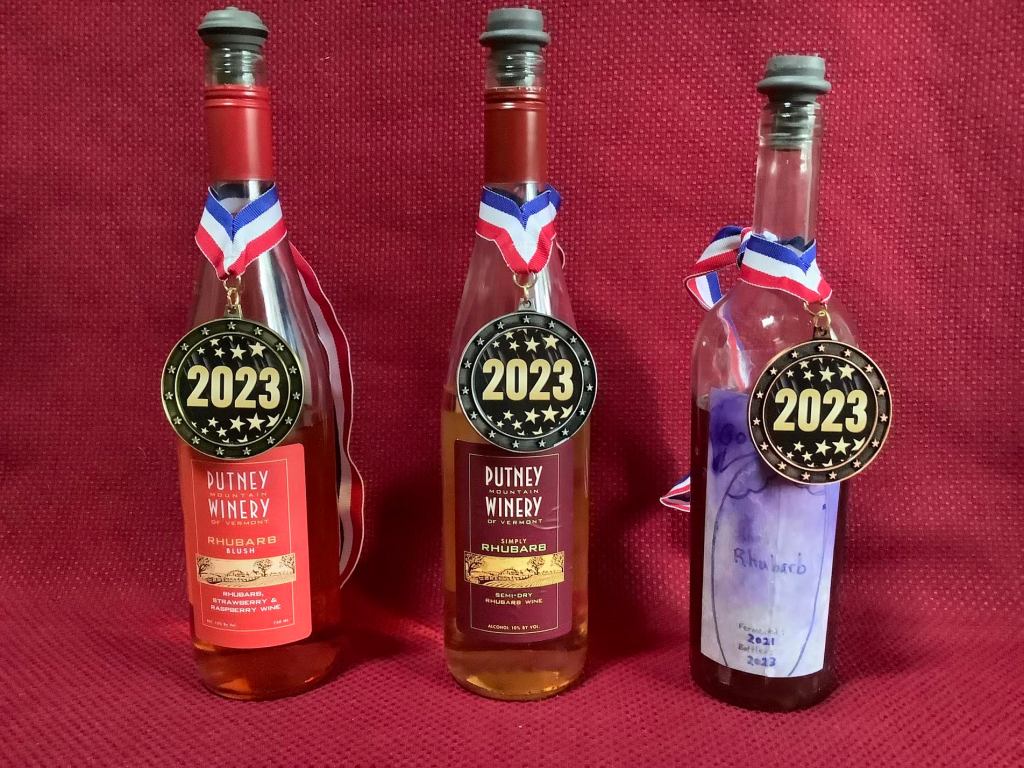
At the Bennington Rhubarb Festival in 2019, we introduced a competition for New England Rhubarb Wines — open to professional and amateur wine makers. The contest went on hiatus during the Pandemic and came back this year for the 2nd time. Although there has been a revival of country wine making in Northern New England, very few of the vintners in Maine, New Hampshire, and Vermont produce a rhubarb wine. The state that makes the most rhubarb wine is North Dakota.
The winning wines from the 2023 New England Rhubarb Wine Competition were from Vermont and New Hampshire.
Try making your own Rhubarb Wine! If you live in New England, enter it in next year’s competition. The recipe that I prefer is from First Steps in Winemaking, by C.J.J. Berry. This looks long and complicated, but most of the effort is in short spurts and the rest of the time the wine is ‘working’ or ‘resting.
Equipment:
cheesecloth or a jelly bag
plastic bucket with 2-gallon volume and a lid
large collander [to fit within the plastic bucket]
large bowl or pot, larger than 1 gallon
hydrometer and cylinder for using it
Camden tablets + Citric Acid, to make sterilyzing solution
2 one-gallon glass jugs [think jug wine]
6 standard 750 ml wine bottles [one for now, 5 for later]
funnel which fits inside a wine bottle
1 jug-stopper air lock
1 wine-stopper air lock
5-6 new wine corks
corking machine or rubber mallet
Ingredients to make 1 US gallon = five 750 ml wine bottles:
2½ pounds rhubarb stalks 2 pounds sugar
1 gallon water
250 ml white grape concentrate
1 tsp yeast nutrient
½ tsp pectic enzyme
2 tsp wine yeast
Day 1
*Camden Solution *Rhubarb, cut in 1” pieces *Sugar
Put the rhubarb and sugar put in a sterilized plastic bucket with a lid. Let sit around 24 hours, until most of the sugar is dissolved. The rhubarb will give off some liquid.
Day 2
*Large bowl/pot of 1-2 gallons in volume *Collander *1 gallon water
*250 ml [1 cup] white grape concentrate
Mark the side of the large bowl or pot so you know where it holds 1 gallon of volume. Pour fruit/sugar into a collander over the bowl/pot. There will still be some sugar in the bucket, so pour some water into the plastic bucket and swirl around. Pour the sugar water over the rhubarb and sugar in collander. Keep pouring water over the fruit to wash the sugar and rhubarb juice from the fruit. YOU MIGHT NOT USE ALL OF THE GALLON OF WATER, due to melted sugar and rhubarb juices. Now you have left-over rhubarb for cooking – suitable for a pie or coffeecake, but not for jam/jelly since it is an unpalatable color. Stop adding water when there is 1 gallon of water/sugar/juice in the bowl. Pour sugar-water back into the plastic bucket. Add grape concentrate to the water in the bucket.
AT THIS POINT, USE THE HYDROMETER TO DETERMINE THE SPECIFIC GRAVITY. Write it down. Add nutrient, enzyme, and yeast to plastic bucket. Cover the bucket.
Day 3
Let sit for 8-24 hours, until it starts to bubble. Little bubbles, not a ‘full rolling boil.’
Day 4
*Camden Solution *1 gallon glass jug *sterilized wine bottle *air-lock for each vessel
Pour wine into a sterilized 1 gallon glass jug.Fill up to 1” below the neck, not to top of the bottle.If you have extra wine, pour it into a sterilized wine bottle so that the wine fills at least half of the bottle.Put airlocks on the jug and the bottle. Label the vessels.Put aside in a dark place that is cooler than room temperature but not cold. Let it sit for 3 months.
Three Months
Sterilized jug
There will be some sludgy-looking stuff [dead yeast and fine sediment, called ‘lees’] on the bottom of the bottles. Sterilize another jug and pour the wine carefully into the new jug so that the lees stay in the old jug. Pour the lees down the drain – it is very good for the septic tank! Top off the large jug with wine from the other bottle.
6-12 Months
*Flashlight *hydrometer
*Sugar syrup [simple syrup]
Check to see if the wine has cleared: Shine a flashlight through it. If it looks cloudy, continue to let it sit. When wine is clear, pour it off into a sterilized jug as before. USE HYDROMETER TO TEST SPECIFIC GRAVITY. IT SHOULD FLOAT AT 1.000. IF IT FLOATS LOWER, ADD SOME SIMPLE SYRUP. IF IT FLOATS HIGHER, LET IT SIT LONGER OR ADD A LITTLE WATER.
Taste a bit of the wine to see if it to your liking. Add simple syrup a bit at a time to improve the taste. DO NOT ADD TOO MUCH OR THE WINE WILL REFERMENT AND YOUR CORKS WILL POP OFF, SPILLING THE WINE.
*Camden Solution *5-6 standard wine bottles *funnel small enough to fit in the neck of the bottles *5-6 new wine corks-*wine corking machine or rubber mallet
Wash and sterilize 5-6 standard wine bottles. Sterilize the funnel. Boil some water, take off heat and submerge corks in the water for no more than 10 minutes. Remove from water and keep on a plate covered with a lid. Pour wine into each bottle until 2-3” below top of bottle. Dip each cork in Camden Solution, then using the corker or mallet, put the cork fully into each bottle.
Label the bottles with the name and date of the wine. Lay bottles on their side in a cool place for one or more years to age and improve before drinking.
This is the blog of the Bennington Rhubarb Festival, which was started in 2013 to benefit the library Building Fund. If you would like to help the Building Fund, please contribute any amount to the G.E.P. Dodge Library Building Fund, Bennington, NH, 03442, USA.
The next installment of this blog will be posted on 29 August 2023. If you click the Follow button, all future posts will be sent straight to your inbox every month.
Now, when the English say ‘pudding,’ they mean any sort of dessert — unless they are discussing Yorkshire Pudding or Blood Pudding. When Americans say ‘pudding,’ we narrow it down to a milk-based dessert to eat with a spoon — such as tapioca or a blanc mange. Here is a real New England recipe from Haydn Pearson, who grew up in Greenfield, NH, just the next town over from Bennington.
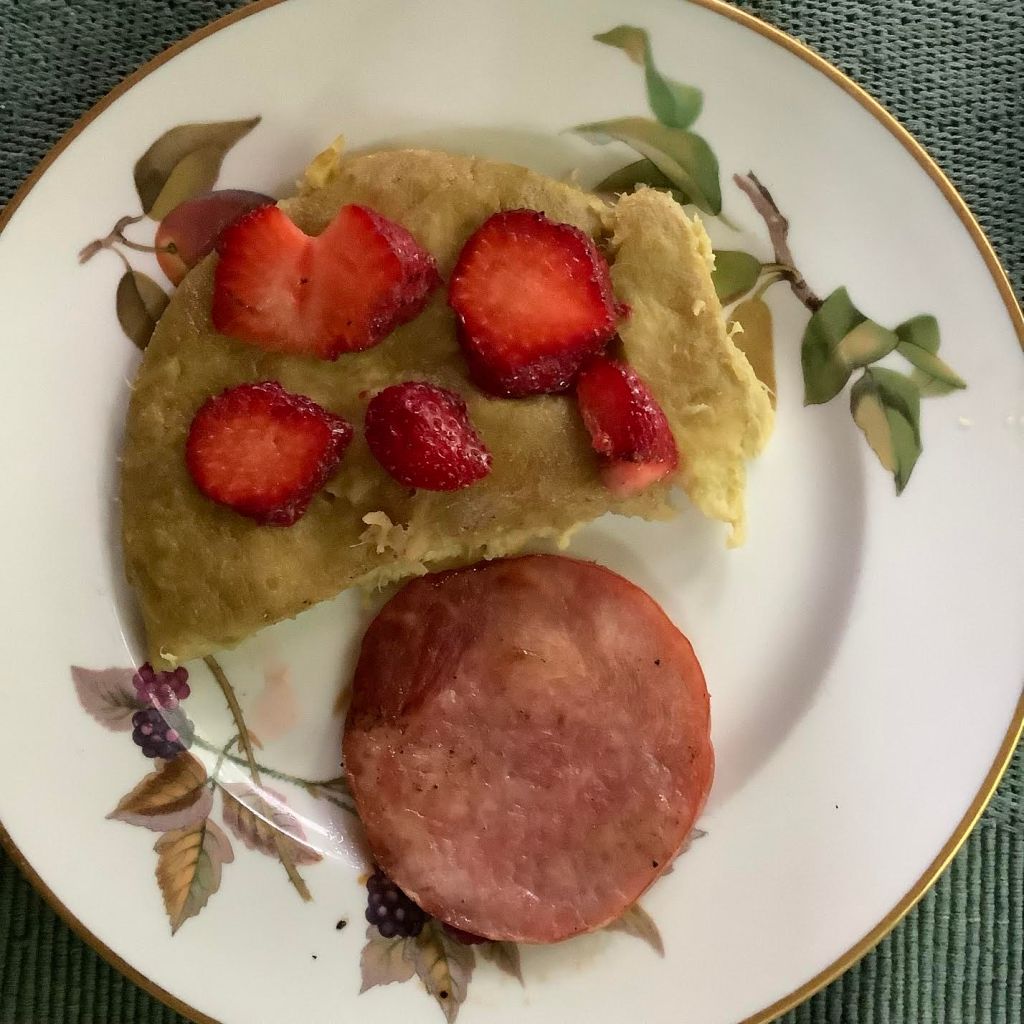
First, Rhubarb Pudding as part of a lovely breakfast. Secondly, Rhubarb Pudding as served for dessert. This pudding is a good way to use the ‘mush’/solids from when you prepared Crushed Rhubarb.
Rhubarb Pudding Breakfast: Haydn Pearson has a wonderful dessert called “Blanche’s Super Rhubarb Pudding” in his iconic Country Flavor Cook Book. This is a scaled-down version that is fit for breakfast: slightly tangy, lightly sweet. Plant Based Gluten Free – if using GF flour
6 Tbsp cooked, mashed rhubarb OR mush from Crushed Rhubarb 1 two-oz egg + 1 egg white 1½ Tbsp sugar 2 Tbsp flour OR 2 Tbsp white whole wheat flour 2 Tbsp milk ½ tsp baking powder per person: 1 slice Canadian Bacon [= ½ oz back bacon] several slices of strawberry
Cut up 1 cup rhubarb and stew it in a little water. Drain thoroughly and mash. OR, use the mush from Crushed Rhubarb. Measure the 6 Tbsp you need and save the remainder for another use. [Add to a smoothie; serve with yogurt] Whisk the egg and white, then add all the other ingredients [but not the bacon!] Spoon into a baking dish which has been sprayed with non-stick spray. HINT: I did all this the night before. A real time-saver. Bake at 350 F until the batter is firm to the touch, about 15 minutes. While the pudding bakes, cook the bacon and prepare the optional beverages. Delicious. FYI, here are the food values for the breakfast: 142 calories 3 g fat 2 g fiber 10.6 g protein 24 g carbs 155 mg Calcium
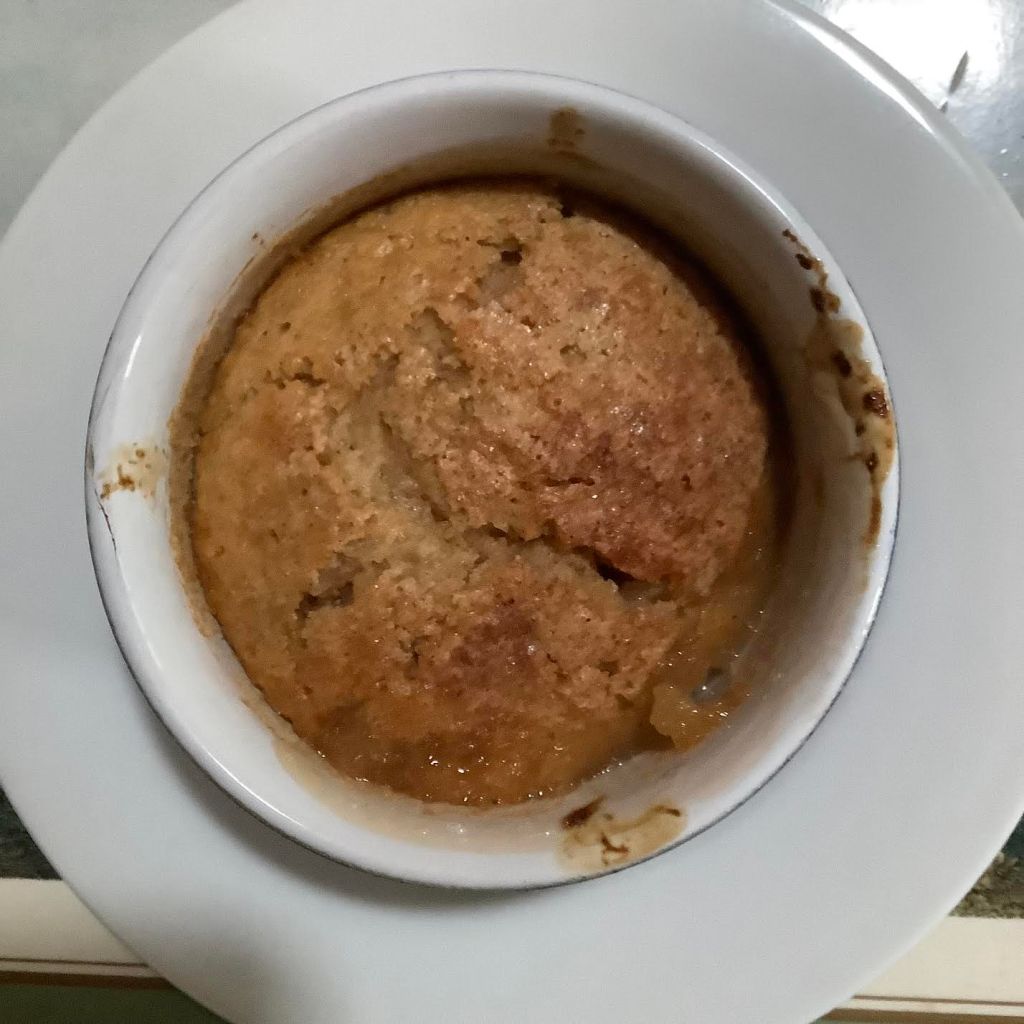
Blanche’s Super Rhubarb Pudding: Blanche was Mrs. Pearson and her husband was delighted with this dessert. You will be too.
Rhubarb Pudding in a single-serving ramekin. What a treat!
Serves 6 in a casserole, 6-8 in ramekins
½ cup sugar 2 Tbsp butter
Cream together.
1 cup milk
Add to creamed mixture.
1 cup flour [white whole wheat is a very good choice] +++2 tsp baking powder +++½ tsp salt
Sift these together, then stir into creamed mixture to make a batter.
1 quart rhubarb, sliced in ½” pieces ++¾ cups sugar ++¼ cup water OR use 3 cups Rhubarb Mush
Cook together over medium heat about 7 minutes. Stir. Pour into a buttered oven-proof dish or into 6 buttered ramekins.
Pour batter over the sauce.
Bake 20 minutes at 350F.
This is the blog of the Bennington Rhubarb Festival, started in 2013 to benefit the G.E.P. Dodge Library Building Fund.
If you would like to help the Building Fund, please contribute any amount to the G.E.P. Dodge Library Building Fund, Bennington, NH 03442.
The next blog installment will be posted on August 1, 2023. If you click the Follow button, all future posts will be sent straight to your inbox every month.
There is more to rhubarb than pie. Much as we love it, there is only so much pie a family can eat — even if you serve it for breakfast, too, like a true Yankee. One of our favorite ways to use rhubarb is to cook it into crushed rhubarb, which can then be pureed. It has many uses.
On left, Crushed Rhubarb with its coarser texture. In center, Rhubarb Puree. On right, a glass of OJ-Rhubarb Juice.
Crushed Rhubarb
This is a variant of Stewed Rhubarb which has been enjoyed for centuries as an alternative to Apple Sauce. Since Crushed Rhubarb is prepared with a higher ratio of water, the result is more liquid, lending itself to serving as a beverage.
Makes 6 cups
5 cups/1½# sliced rhubarb 4 cups/1 L. Water
Simmer in a sauce pan 20 minutes or until rhubarb softens and starts to break down.
Stir, crushing rhubarb with back of spoon. Cool.
The Crushed Rhubarb may be canned in a hot water bath.
USES FOR CRUSHED RHUBARB– use the crushed rhubarb and its liquid instead of orange juice in a smoothie, such as one of these:
After cooking crushed rhubarb, cool the mixture, then run it through a blender/VitaMix to puree it. Jars of puree may be canned in a hot water bath for 15 minutes or frozen.
Uses For Rhubarb Puree: 1.] Use in Smoothies, as above 2.] Use to supplement Orange Juice why supplement your orange juice? 1] better nutrition : reduced calories, increased fiber, increased Calcium, reduced sugar 2] makes purchased OJ go further, saving money
OJ+Rhubarb Juiceyields 8 cupsThis was a real hit at the Drink Your Rhubarb table at the Rhubarb Festival! You should try it. 2 cups Rhubarb puree + 6 cups commercial orange juice Stir together and store in refrigerator.
comparison
calories
fat
fiber
protein
carbs
Calcium
Sugar
1 c. rhubarb PUREE
21
0.2 g
2 g
1 g
4.6 g
87 mg
1 g
1 c. orange juice
110
0 g
0 g
0 g
18g
20 mg
24g
1 c. OJ+Rhubarb
87
0 g
0.5g
0.2 g
46g
37 mg
18 g
Rhubarb Juice
After cooking the Crushed Rhubarb, strain the pulp from the liquid. The color of the juice will vary from light pink to greenish-brown depending on the color of the rhubarb stalk. [I usually save the red parts of the stalks for making the Juice] The juice may be canned in a water bath.
Yield from full batch of rhubarb: 3½ cups of juice + 1½ c. rhubarb mush Yield from 2 cups crushed rhubarb: 1½ c juice + ½ cup rhubarb mush
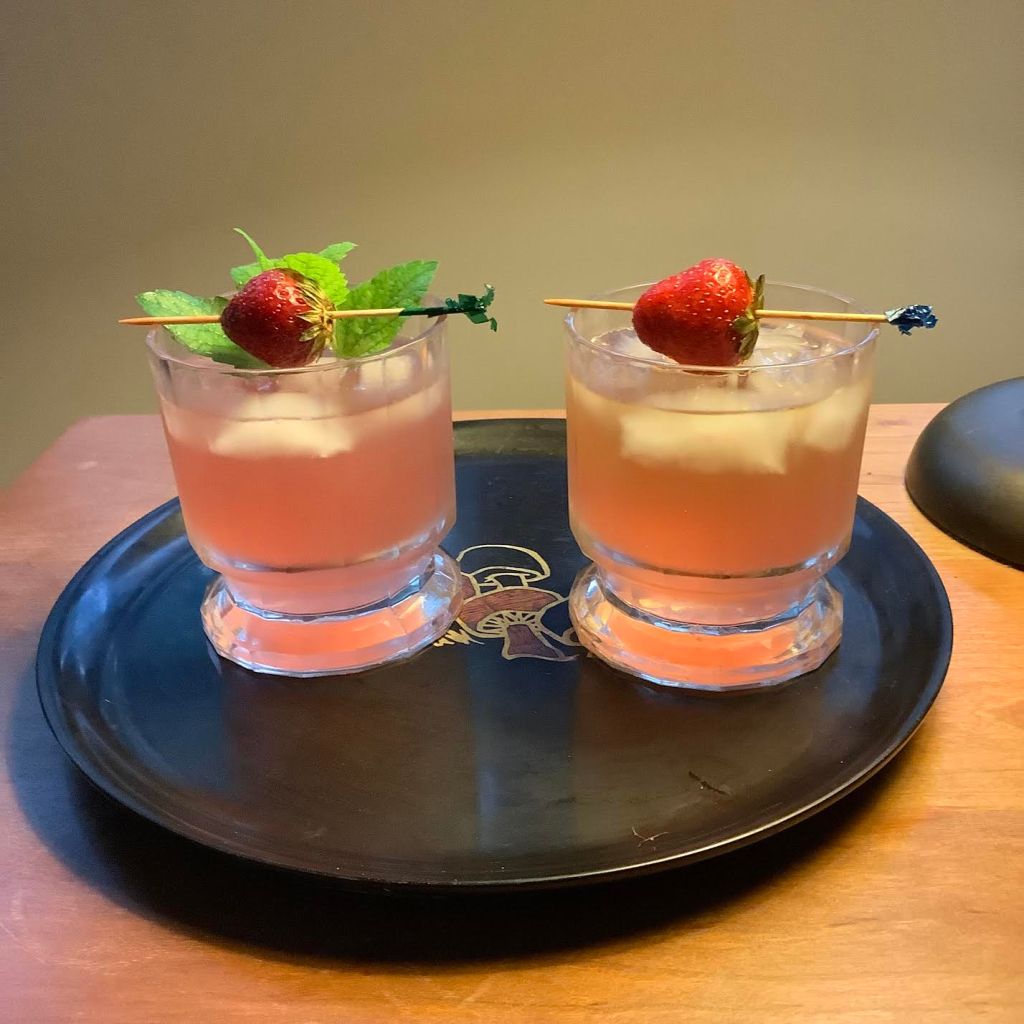
Summer Sipper on the left, R ‘n’ R on the right.
USES FOR RHUBARB JUICE >>>Summer Sipper: Add ½ cup sugar to 4 cups warm, strained juice, cool it, and drink over ice, garnished with a strawberry and a sprig of mint. Very refreshing.
>>>R ‘n’ R Cocktail: ½ cup Rhubarb Juice with sugar + 1 fluid oz rum, served over ice and garnished with a whole strawberry.
This is the blog of the Bennington Rhubarb Festival, which was started in 2013 to benefit the library Building Fund. If you would like to help the Building Fund, please contribute any amount to the G.E.P. Dodge Library Building Fund, Bennington, NH, 03442, USA.
The next installment of this blog will be posted on July 4, 2023. If you click the Follow button, all future posts will be sent straight to your inbox every month.
Two of the hottest topics at the Bennington, New Hampshire Rhubarb Festival are: where can I buy a pie? and who won the Rhubarb Pie baking contest? Rhubarb pie has been baked in England and the USA since the 1700s.
If you want to enter the Pie Baking Contest at the Bennington Rhubarb Festival, you should know how to make a pie. Here is a tutorial. But be aware: although the recipe is really quite simple, there are controversies at each stage of preparation.
In 2018, the Town Select Board turned out to judge the rhubarb pies. They were very serious about the job.
Crust: Lard or butter? Oil or shortening? Which fat to choose to make a flakey crust is a perennial debate. There is no hard and fast rule on this. Find a good recipe for a butter crust or a lard crust or a combination of the two. NOTE: for the Rhubarb Festival Pie Contest, you must prepare the crust with some sort of King Arthur Flour, and prove it by showing the bag that contained the flour.
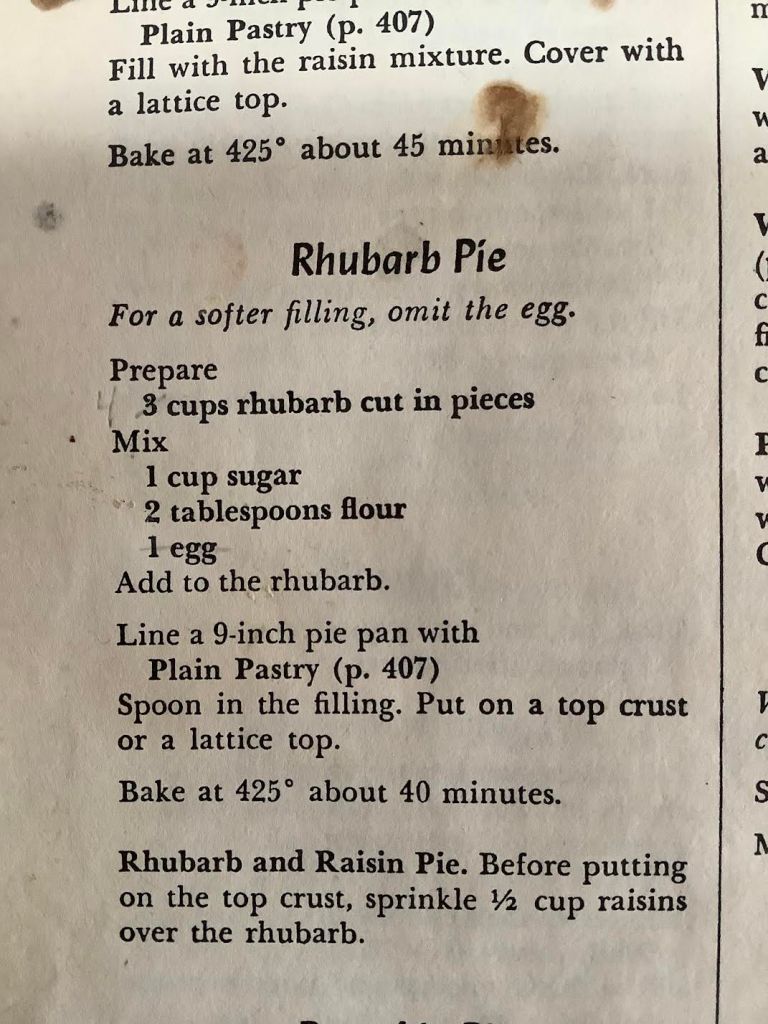
Sugar: How much? To consult some well-known New England experts, Fannie Farmer’s Cookbook uses less sugar than Hayden Pearson in his Country Flavor’s Cookbook. My mother used so much sugar in her pie, that there was a layer of it on the bottom crust. Too much sugar negates the delightful tartness of rhubarb.
Thickener:Flour? Tapioca? Corn starch? Many, many opinions on this topic! Rhubarb is so juicy that it requires something to sop up the liquid. Read the link provided, and make up your own mind.
Egg: yes or no? Fannie Farmer says ‘yes.’ Hayden Pearson says ‘never.’ One egg helps to firm up the innards of the pie. Two eggs make it a custard.
Topping: Lattice or top crust or crumble? Full top crust is familiar. Lattice makes it look special. Crumble top is easy, though some say that is reserved for an apple pie.
From the Fannie Farmer CookbookFrom Pearson’s Country Flavor Cookbook
Here is my recipe, for what it is worth…
Serves 6-8
9” pie plate
dough for 1-2 pie crusts
Prepare dough. Roll out half and line pie plate.
4½ cups rhubarb
Cut in ½” slices and put in a large bowl.
1 cup sugar— 2 Tbsp King Arthur White Whole Wheat Flour –1 two-oz egg
Add these all to rhubarb and stir well to incorporate all ingredients and to coat the rhubarb evenly. Scrape into lined pie plate.
Topping 1: Pie dough for 1 crust
Wet the edges of the bottom crust with water. Roll out into a large circle and lay it over the pie. Trim edges, then crimp the crusts together decoratively.
Topping 2: Pie dough for 1 crust
Roll out into a large rectangle and cut long strips, each ½’ wide. Lay strips over the pie and weave them over-and-under to form a lattice top.
Topping 3: ½ c rolled oats— ¼ c flour— ½ c brown sugar — ¼ tsp cinnamon —5 Tbsp butter
Put these in a food processor and pulse until they form crumbs. Scatter a healthy amount atop the pie. You may have some left over for another pie.
Heat oven to 400F. Bake pie 15 minutes. Turn heat down to 350F and bake 30 minutes until bubbling in the center. Cover with foil if browning too rapidly.
There are two categories in the Pie Contest at the Bennington Rhubarb Festival.
Section
Description
Prizes
1.King Arthur Baking Contest
Pie: > 100% rhubarb – no other fruits added >7-9” in diameter, >1 or 2 crust > in disposable pan > must show the opened bag of King Arthur Flour used to make the pie or show the UPC cut from the bag. > open to amateur bakers of all ages.
1st $75 gift card for King Arthur catalogue + Ribbon 2nd $50 catalogue gift card + Ribbon 3rd $25 catalogue gift card + Ribbon
2. Professional Baking Contest
>100% Rhubarb Pie any size >1 or 2 crust in disposable pan > open to bakers from restaurants and bakeries
1st Prize Rolling Pin
This is the blog of the Bennington Rhubarb Festival, started in 2013 to benefit the G.E.P. Dodge Library Building Fund.
If you would like to help the Building Fund, please contribute any amount to the G.E.P. Dodge Library Building Fund, Bennington, NH 03442.
The next blog installment will be posted on June 6. If you click the Follow button, all future posts will be sent straight to your inbox every month.
Every year at the Rhubarb Festival, we are asked, “Just what is Rhubarb?” So if that is where you are starting, you have come to the right place.
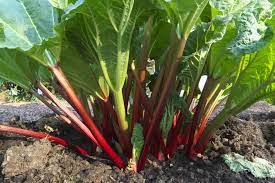
Rhubarb is a very hardy perennial plant, so tenacious that it will survive from growth zone 8 to zone 3. It is part of the Buckwheat Family [Polygonaceae] of plants, the cousin of sheep sorrel and curly dock [Rumex crispus]. Garden rhubarb in the United States is Rheum rhabarbarum, one of dozens of varieties within that Genus. The roots are long, woody, and look somewhat like huge carrots. They are referred to as ‘crowns.’ Around here, the Rhubarb starts to come up in April: a red, bud-like knob of curled leaf, crowning through the soil. Then come the stalks, pushing the leaves higher into the air. The stalks can be three feet tall, colored red or green. The leaf is heart-shaped and very wide. At this point, the stems can be harvested for eating. [What can one cook with rhubarb? Several future blogs will address that, recipes included.] Please note: although those leaves look good enough to eat, they contain high amounts of the toxin Oxalic Acid. DO NOT EAT THE LEAVES.
From the first pink buds pushing up, to the full leaf unfurling, it is a treat to watch the changes as the Rhubarb grows. photos from University of Wisconsin-Madison.
By June, the flower stalks rise high above the leaves, carrying bunches of tiny, frothy flowers looking like cumulus clouds. Gardeners in the know are aware that these stalks must be cut down. If a Rhubarb plant blooms, then the stalks become too tough and woody to eat. This has lead to the erroneous notion that Rhubarb is available only in the Spring. No so. If you cut down the flower stalks, you can harvest the stems until September.
At the Bennington New Hampshire Rhubarb Festival, there are contests for ‘Longest Stalk’ and ‘Widest Leaf,’ as well as ‘Rhubarb Photography’ and ‘Rhubarb Flower Arrangement.’
Rhubarb stalks come in many colors, which has no affect on the flavor or tartness.Rhubarb flowers can make a nice arrangement.
The next installment will be posted on May 9. If you click the Follow button, all future posts will be sent straight to your inbox every month.